
Harmony tonearm - a versatile wonder
Harmony tonearm by Eugene Kommissarov.
Eugene is Russian but lives already for many years in Belgium together with his wife Olga.
I met them at ETF some years ago as I had contact with Darius from the desirable Dava fieldcoil
cartridges. Darius told me to have a look at Eugene's Harmony tonearm as it would suit
his cartridge very well, and it was present at ETF at that time. So I did. At ETF a demo
was given and the tonearm impressed me but it was hard to judge its qualities as this is
always difficult on a different system. A few months after ETF I contacted Eugene and we
arranged for a meeting and a demo at my home, in my system. Nice!
As I like to audition with friends I invited some over as well. The tonearm was installed
by Eugene the evening before so we could immediately listen to it the next day.
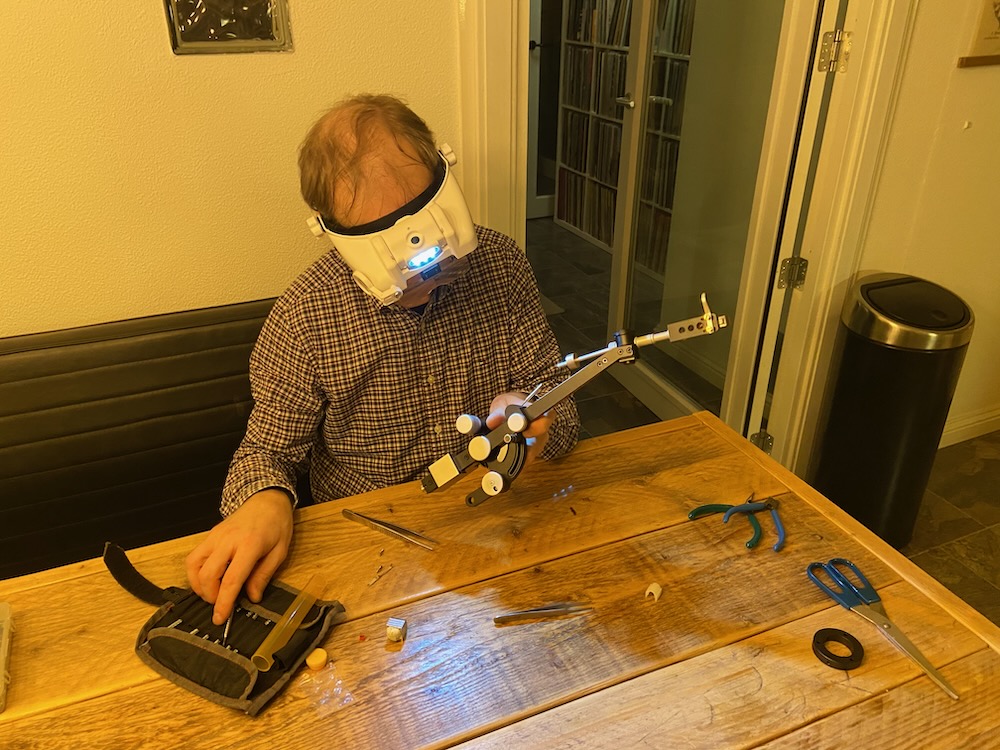
Eugene making adjustments to the tonearm before installing it.
As I had no phono interlink with included power supply wiring for the fieldcoil, and the
one that Eugene brought was a little short on length, we decided to start with my Koetsu
Tigereye. Actually a nice choice as the Koetsu was known very well by my friends, so this
allowed for a nice impression for all. Actually setting up the tonearm took some time as
there are many options and possibilites to optimise. Smart thinking to set it up the
evening before!
Installed and playing!
Then it is time to see and hear it in action. As said, the Koetsu Tigereye was first installed.
At this time I had no experience setting it up as Eugene did all the honors at my home.
The tonearm has a solid tech-look and looks complicated. In essence it is due to the
many possibilities to install it perfectly.
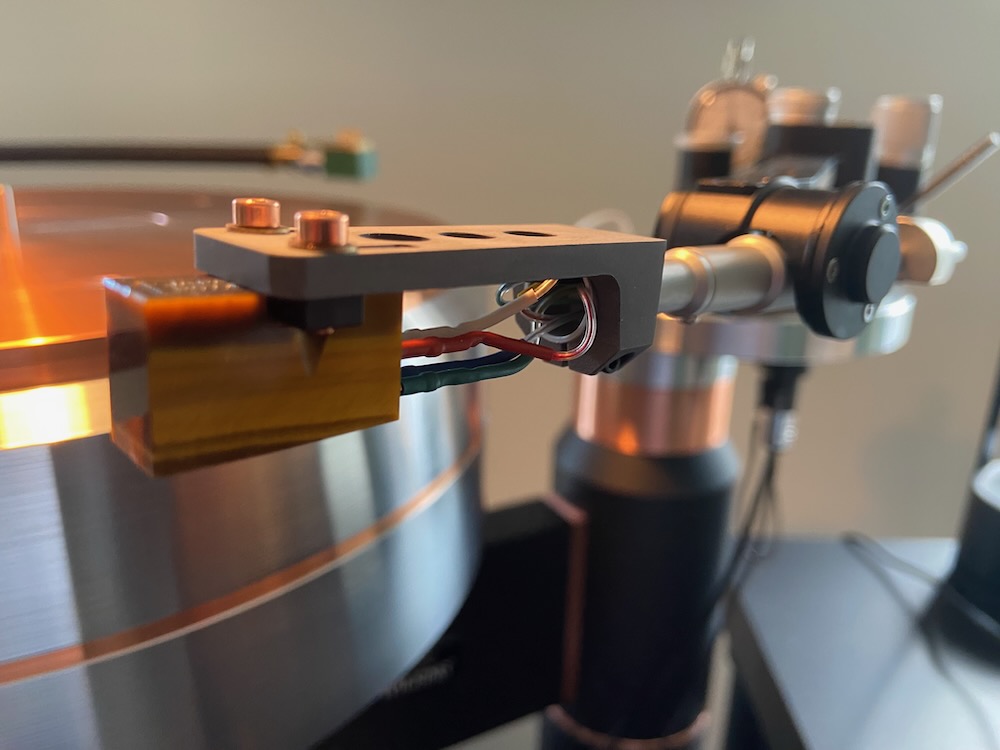
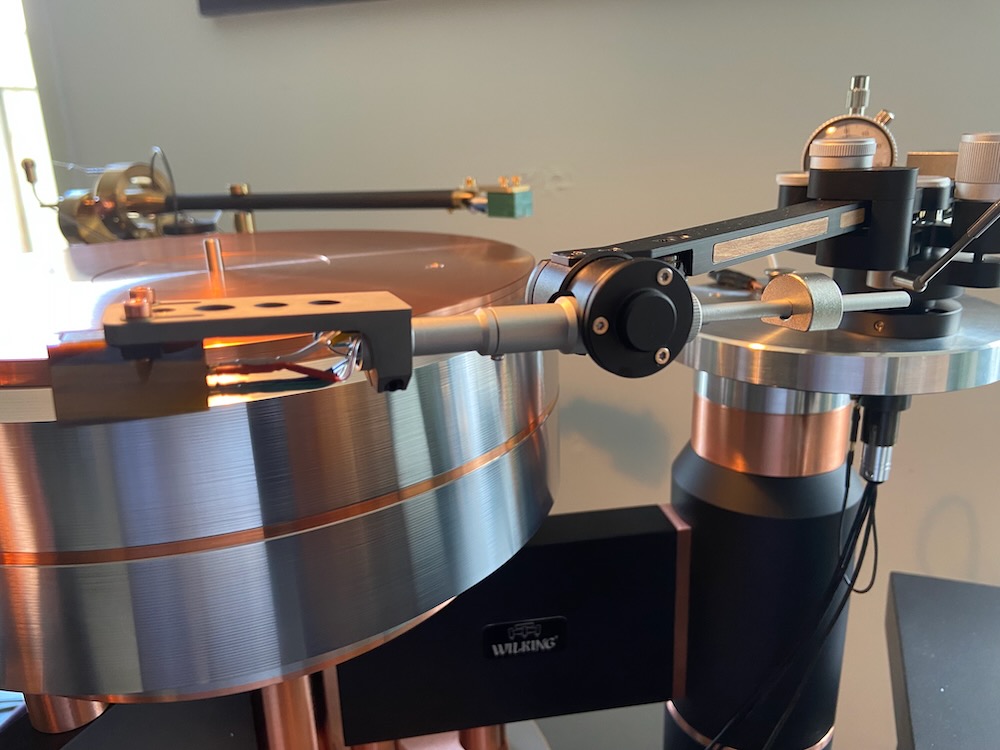
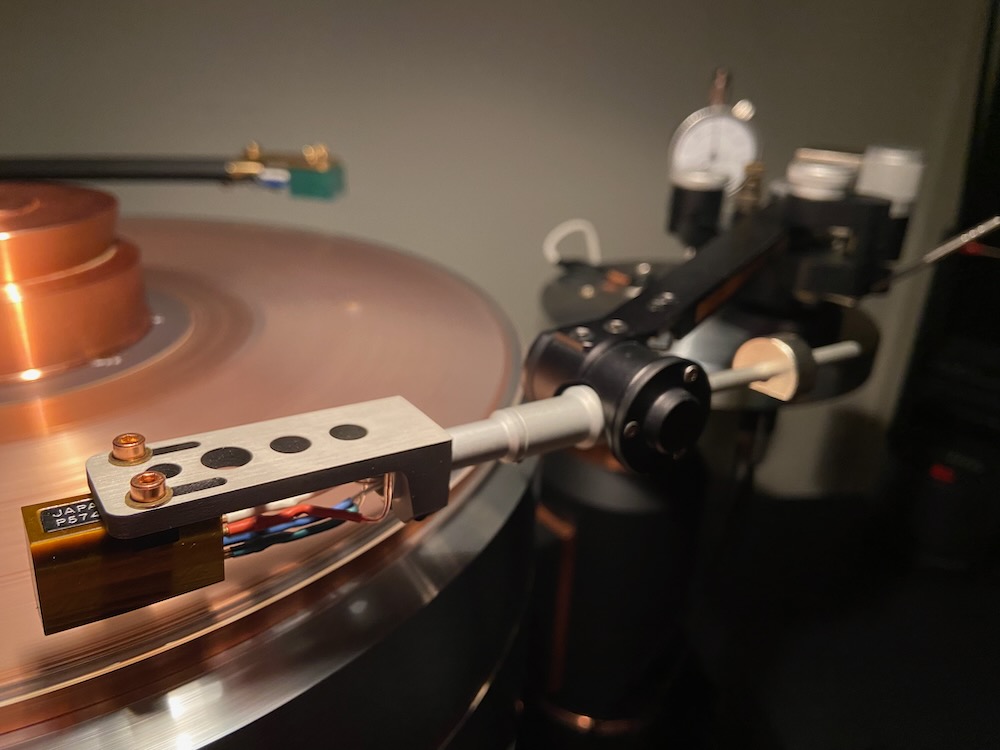
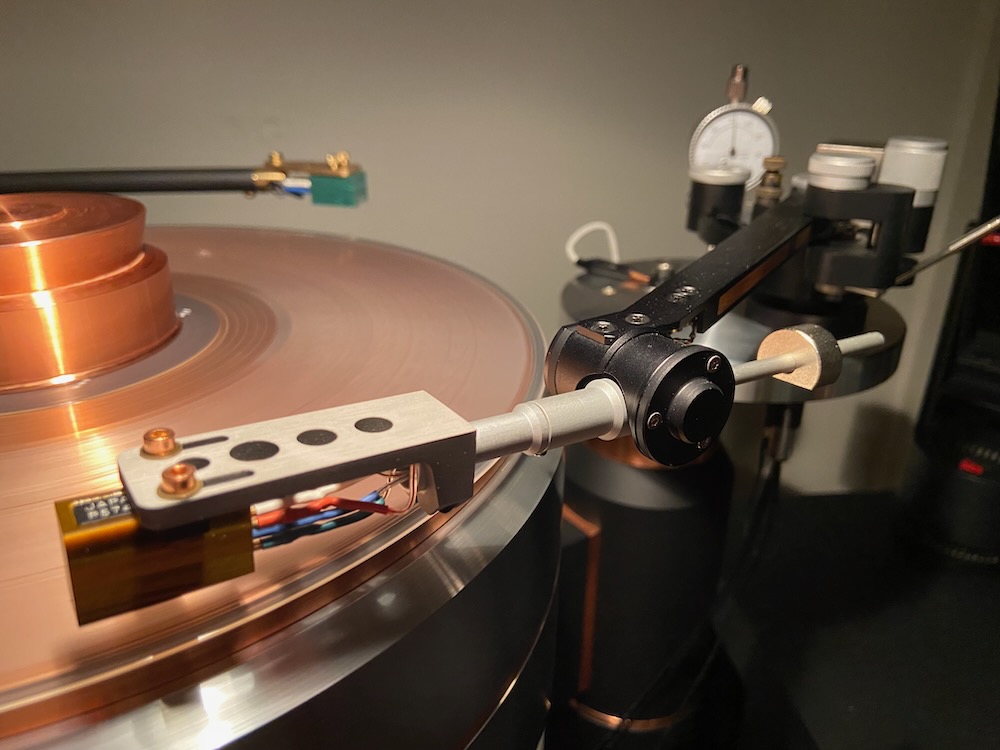
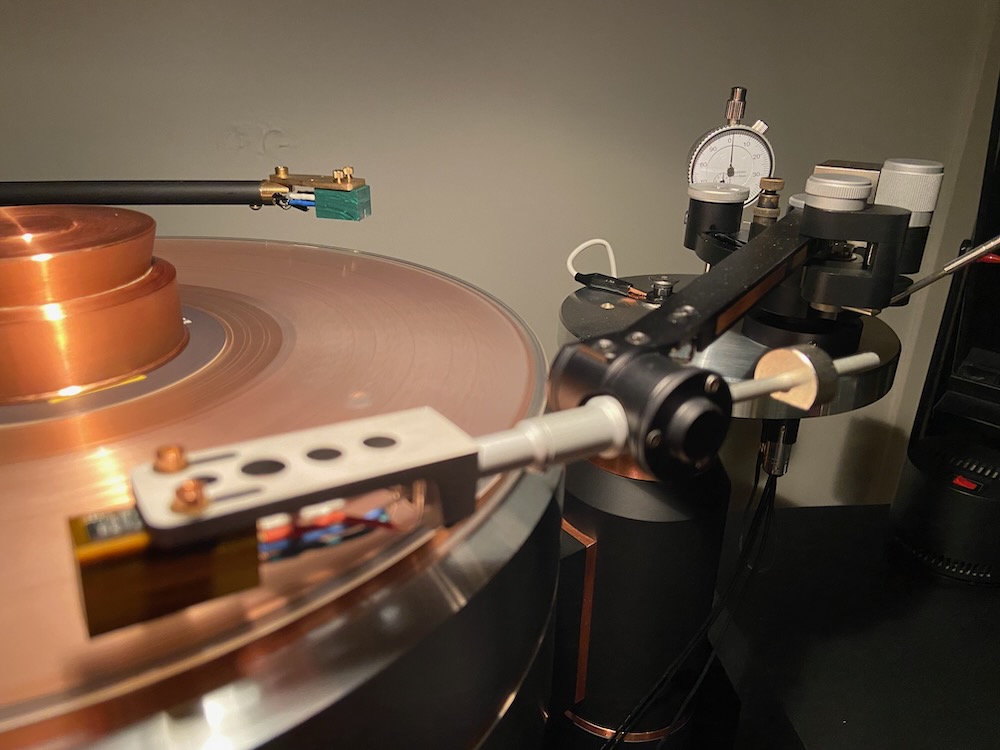
When the tonearm was lowered onto the record, the first 'thumb' from the needle hitting
the groove said a lot. This indeed is a very good tonearm! Once the music
started to play my friends were silent, not only out of curiosity but mostly because of
the impressive quality in playback. Every aspect and detail in music was convincingly
tonefull and clear. Imaging was rock solid and deep. The kind of quality that immediately
invites to play more music, more records. The Koetsu was pleased in any way! After some
time Eugene showed that during playback the VTA can be adjusted and the anti-skating,
allowing to find the optimum adjustment when listening. So we did and this was clearly
audible. What was extremely good got even better. More focus, more blackness. So we played
lots more records. Then after some time Eugene suggested to use the viscous damping, to
a certain extend, as that can be regulated as well. Setting it half way, so to say, added
for some more rest in the sound image, some liked it, some not so. Matter of personal
preference. However, everybody was convinced about the quality of the tonearm, the build
quality, the installment options but most of all the added quality to music playback.
Most certainly the best I had in my system so far, and that were a lot.
How about the Dava?
Yes, the reason to try the Harmony at first. I had the Dava Ref, one of the first versions,
the heavy one. To get it installed properly, almost all settings of the tonearm had to be dialed
to maximum, not allowing for finetuning.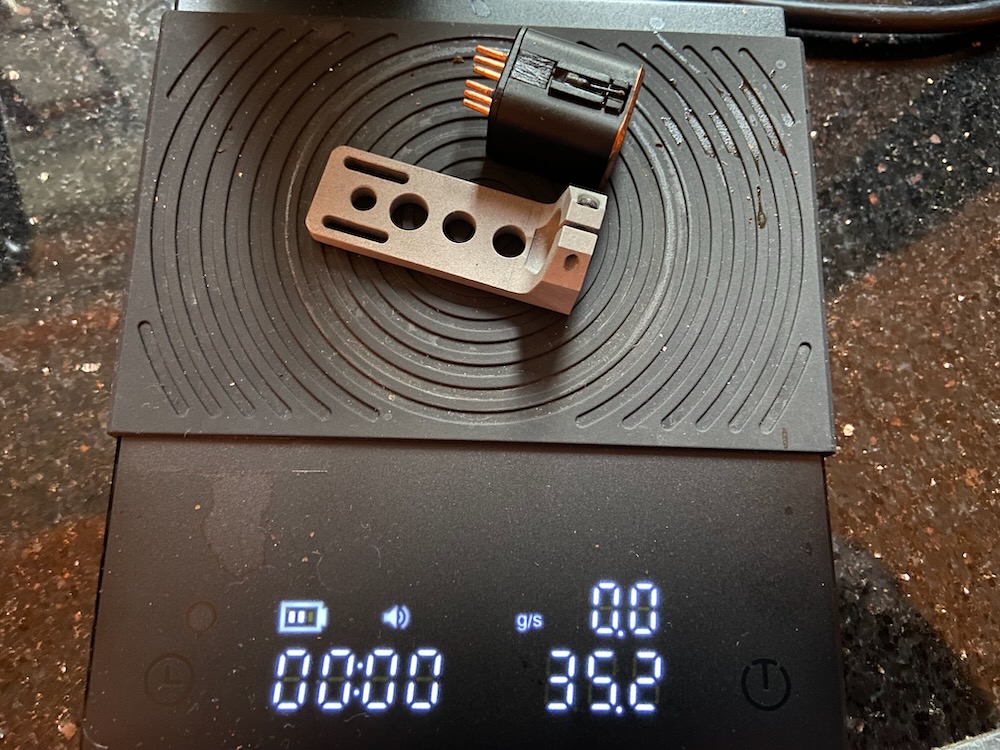
So I asked Darius if it could be upgraded or updated to a less weighty one. This was
possible but a better solution crossed my path: to get the latest version Dava, the Major.
At ETF.25 I got handed over the Major and installed it right after ETF. This was all the
time the goal, to play the Dava and Harmony as a team. I made a phono cable that supports
the power supply voltage for the fieldcoil as well and hooked it up to the power supply.
This was the first time I had to set it up myself, Eugene had done this for the Koetsu. Now
it became clear that the many possibilities also created a challenge.. To get all the
parameters for the Major right, an organized sequence of actions was necessary to get to
the perfect set up. A lot of options is marvelous, but then you need to know what is
about what. Ha! This might be a sort of downside for the Harmony tonearm.. the sheer
amount of options to set it up. You really need to know what each option addresses and
how to get the optimum for all together. Well, I am not a rookie, so to say, but I had to
contact Eugene several times.. His respond was swift and clear, he guided me to the
best combination in options for the Dava Major. Great!
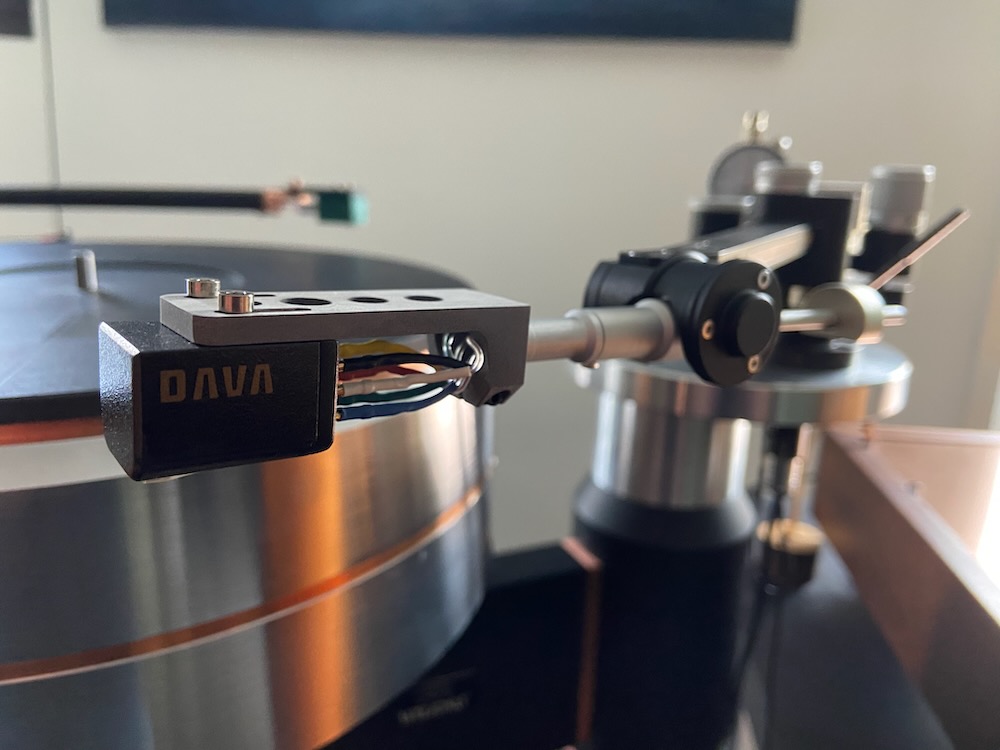
Once it played, it played at its best. I hope. Yes, different from the Koetsu Tigereye, of
course. Where the Koetsu has a preference for the lower mids and lows, the Major excels in
all frequencies, making for a very flat response. Tonally correct, almost fairy-like
without being too kind. Brutal when needed, soft when asked for. Darius said that its
playback could be compared to mastertape. I never heard a mastertape but now have an idea
what that sounds like. It is beautiful and draws attention to the music, to the composer, to
the actual meaning when the music was written. I think, as I have really no idea what
a composer was thinking during this process, of course. But you get the idea..
This combination is by far the best ever in my system, not only for me but for all
who auditioned it since it was set up. You know, there is always discussion, except when
playback is really, really good. Than everyone shuts up and listens.. this is exactly what
happens when I play this combination..
Availability
At this moment (December 2025) the tonearm is not in production yet, this is about a custom
order. When interested contact Eugene at eugen.komissarov - at - gmail - dot - com
or drop me a line. I will forward your questions.
Some more info - geometry.
This tonearm is different from most tonearms as it has one part that rotates
horizontally and a part that moves vertically. Just like Dynavector DV5-series but different.
I once owned and played a DV501 and I liked it very much, however I replaced it by a
Bokrand at that time, for some reason. The Harmony looks alike but is way different in
construction, not to say the endless possibilities for proper set-up.
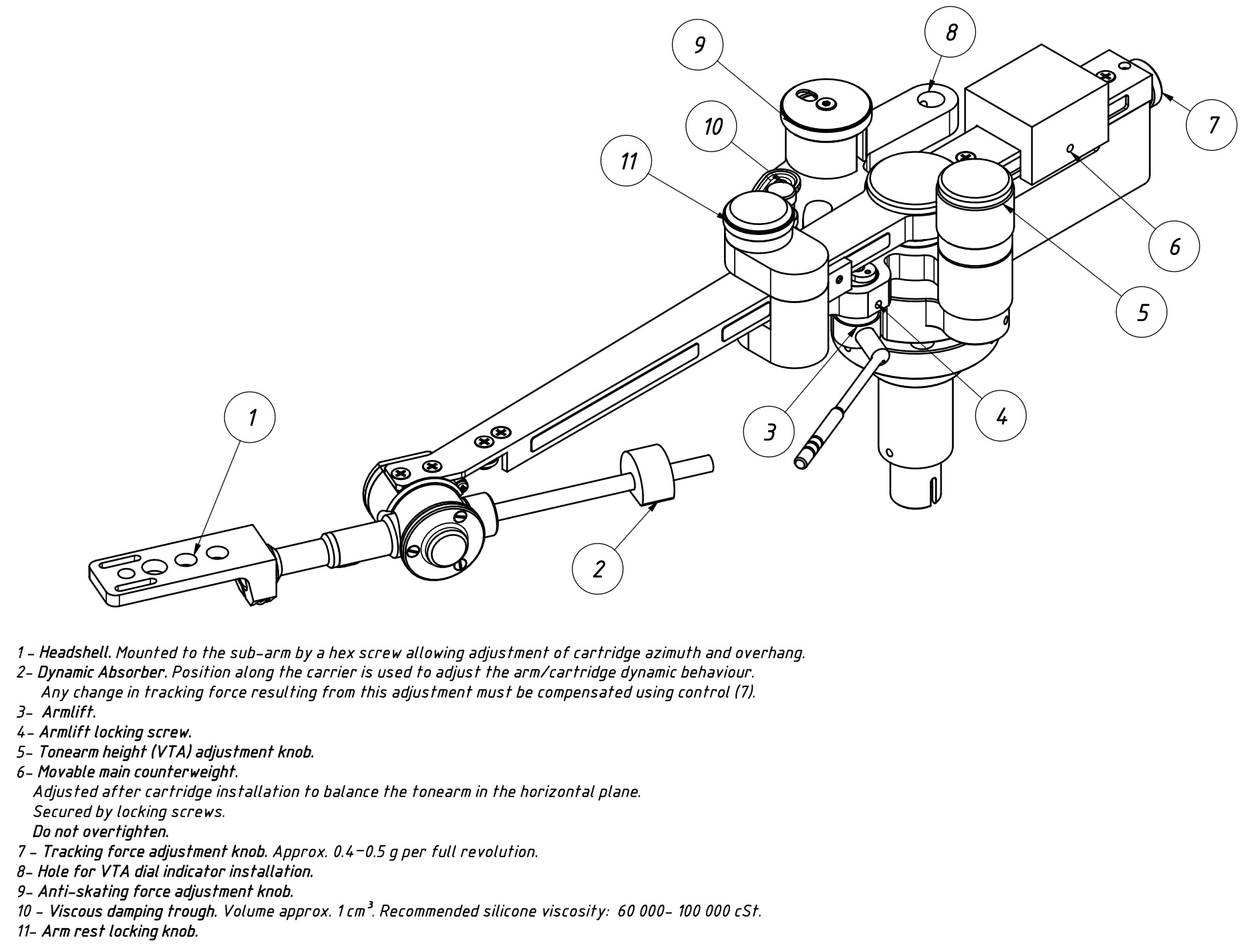
As the description tells:
The tonearm is equipped with three systems of damping the main resonances of the cartridge:
The resonance damping, which is set to the resonance frequency of the cartridge with the
adjustment range of 8...15 Hz is in the vertical plane. It works with the help of a
counterweight on the sub arm, which is needed for damping, and only partially balances
the cartridge. There are two damping systems in the horizontal plane: resonance (dynamic
damper) one with the range of 6...14 Hz and adjustable viscous damping, which allows
to set the optimal damping for any cartridge. The small reduced mass in the vertical plane and
the adjustable damping permit you not only to use any modern or vintage cartridges, but to unlock
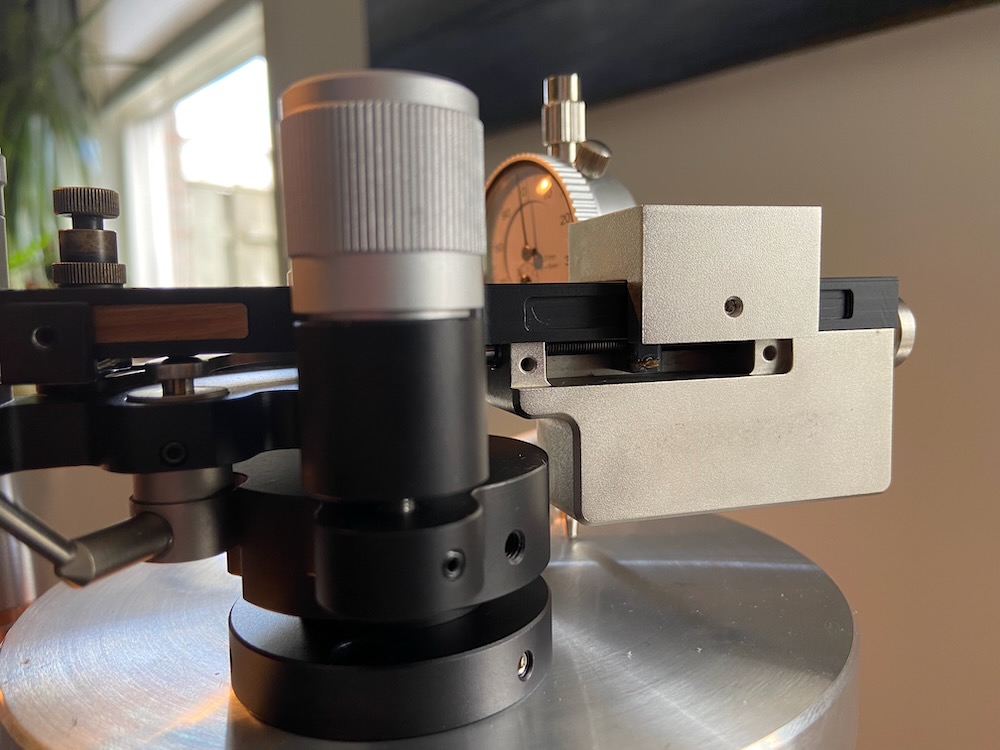
the potential of both light and heavy ones. The height adjustment system (VTA) with a
micrometer screw is equipped with a dial indicator of the clock type and lets you to
set the VTA -on the fly- and track the height of the tonearm on the indicator, which
greatly simplifies the setting. Anti-scating main spring top system allows the
-on the fly- setup. In the Parking-state, the tonearm is fixed in two ways – with the
help of a magnet and - a rotary lock to ensure safety in the period between auditions.
The high-quality ball ceramic bearings of axes have unlimited service life and do not
require maintenance. In the horizontal plane, the tonearm is dynamically balanced
(the center of mass is on the axis of the bearings between them), this makes the tonearm
insensitive to the horizontal position of the turntable and reduces the susceptibility
to external vibrations.
These are the technical features:
- The tonearm has spaced horizontal and vertical axes of rotation ("vestigial system"), effective length of 305mm and is compatible with standard SME-shell.
- The tonearm`s mounting hole is compatible with EMT/Ortofon cartriges Tonearms.
- The tonearm`s beam shape and design are anti-resonant and prevent the occurrence and propagation of standing waves (ringing).
- The preferred type of cartridge is medium and heavy, with a pliability of 2....10 um/mN.
- The tonearm`s reduced mass without shell`s mass in the vertical plane is adjustable in the range of 4-15 g.
- The downforce is set by a mainspring that compensates the weight of the cartridge, so the center of mass in the vertical plane (subarm rotation) is shifted to the pickup needle, this significantly improves the work on bent and warped vinyls, and also allows you to get rid of the shock load on the bearings.
- Download the manual
Write up by Eugene about the vestigial system
Why "vestigial" system's is a better?
The vestigial system`s advantages.
The tonearm`s parasitic oscillations are caused by two types of the vinyl`s inevitable defects – eccentricity and warping. The first one causes oscillations in the horizontal plane with a frequency below 1 Hz while the second one and other defects (such as humps, etc.) provoke oscillations with a frequency of 2-10 Hz. Since the Low-frequency signal is mainly recorded in the horizontal plane (monoural signal L+R), and the parasitic oscillations are in the range below 1 Hz, the optimal resonance of the pickup in the horizontal plane is in the range 2-9 Hz. However, the optimal resonance frequency in the vertical plane is higher – about 10-15 Hz.
These conflicting requirements show that the tonearm should be heavy (more than 40 g of the reduced mass) in the horizontal plane, and extremely light in the vertical one. This problem is solved by the separation of the axes of rotation and getting rid of the counterweight. But such a decision itself is not enough. Increasing the mass together with a decrease of the resonance frequency enhances its quality factor (a large mass is more difficult to stop) and requires a special attention to its damping, whereas the resonance of 11-12 Hz in the vertical plane usually does not need an additional damping at all (the cartridge`s dampers are effective enough).
It is for this reason that two horizontal resonance damping systems can be used, both are very efficient and complement each other. The resonance damper consists of two elements – the flexibility (rubber ring or elastic element) and the mass. They have the opposite properties – the flexibility resistance (mechanical impedance) decreases with the increasing frequency (the higher the frequency of the impact, the easier it is to bend the mainspring or suspension), while the mechanical impedance of the mass grows with the enhancing frequency (the higher the frequency, the more energy it takes to cyclically change the direction of the mass). Such elements are called Reactive, and they create a Reactive resistance – Impedance.
The reactive impedance is phase shifted relative to the excitation signal. The frequency at which the impedances are equal is the resonant frequency. The electrical analogy of the mass is the inductance, while the flexibility`s one is the capacitance. The vibrations of the cartridge are suppressed at the resonance frequency as they are in the antiphase with the damper.
Hence, there is an important consequence – the flexibility becomes incompressible below the resonance frequency and the mass can be considered rigidly attached, when it is isolated from the tonearm through the malleability of the damping element above the resonance frequency.
The viscous type damper or the electromagnetic (eddy current) damper create a so-called ‘active resistance to a movement’, which does not depend on frequency. Its electrical analogue is resistance R. For the reason of the influence over the entire frequency range the viscous or eddy current damping should be not only applied with caution and in the right proportion with other types of damping but also be able to adjust.